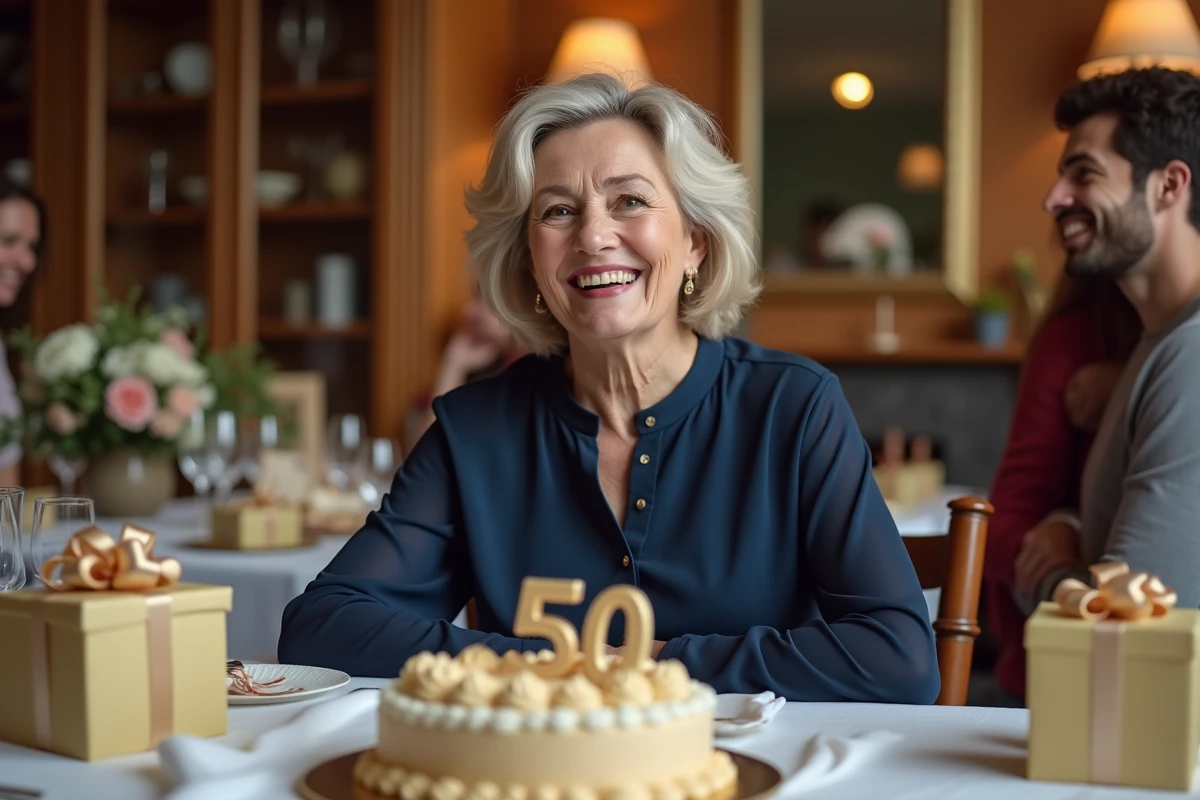
Giving money for a 50th birthday raises a question that most guests prefer to dodge: what amount is appropriate without appearing stingy or excessive? The half-century mark is still seen as a symbolic milestone, and the sum slipped into the envelope or contributed to an online pot reflects both the relationship with the person and the financial situation of the giver.
Gift of use or donation: the tax limit that few guests know
Before discussing amounts, a legal point deserves to be made. The High Council of Notaries has been reminding since 2023 of the distinction between gift of use and donation. A gift given on the occasion of a birthday, including cash, remains a gift of use as long as it is proportionate to the income and wealth of the donor.
Specifically, an amount that represents a modest fraction of the donor’s monthly income does not trigger any reporting obligation or impact on donation allowances. On the other hand, a transfer of several thousand euros given by a close relative with modest income could be reclassified as a donation by the tax authorities. The ministerial response published in the Official Journal on May 9, 2023, confirms this logic of proportionality.
To know how much to give for a 50th birthday, one should start from their own financial capacity rather than a universal scale. An amount that goes unnoticed in the budget of a senior executive may represent a considerable effort for a student or a retiree with a modest pension.

Amount of a gift for 50 years: how the relationship with the person really changes things
The emotional or social bond with the honoree remains the most determining factor. Customs vary, but three main categories emerge quite clearly.
- Members of the close family circle (spouse, children, siblings) generally fall into the highest amounts. For a 50th birthday, it is not uncommon for adult children to pool their resources to fund a memorable experience (trip, weekend, activity) rather than each giving a separate envelope.
- Close friends adjust their contribution based on the form of the gift: participation in a collective pot, individual gift, or invitation to dinner. The trend observed in recent years leans towards the collective gift, which allows for a more ambitious overall budget while spreading the effort.
- Colleagues and acquaintances contribute more modest amounts, often as part of an organized collection at the office. The amount contributed by each reflects more of a group norm than a personal choice.
The individual amount depends as much on the format of the gift as on the emotional bond. A friend participating in a pot of ten people will not contribute the same amount as if they were giving a gift alone.
Online pot for a 50th birthday: why the format changes the game
The Leetchi 2024 barometer shows a marked increase in pots labeled “50 years” between 2022 and 2024. This progression reflects a change in behavior: loved ones prefer to pool their contributions to offer a collective experience or a unique purchase of value rather than multiplying small individual gifts.
This format alters the thinking about the amount. When a pot gathers fifteen participants, each individual contribution can remain modest while reaching a significant total. The organizer of the pot plays a key role: they often set a suggested amount or leave it up to each person to contribute what they wish.
Field feedback varies on this point. Some organizers believe that indicating a reference amount facilitates participation, while others find the approach awkward. Pot platforms generally allow for a choice between free contribution and suggested amount.
The psychological effect of the visible amount
On most platforms, participants can see the total accumulated but not always the details of individual contributions. This parameter influences behavior: when individual amounts are hidden, the gaps between participants widen without creating discomfort. When they are visible, a form of alignment occurs naturally.

Experiential gift or envelope of money: the choice that weighs on the budget
Recent surveys on experiential gifts confirm a fundamental trend among people in their fifties: the preference for experiences (trips, wellness stays, cultural activities) has significantly increased since 2020. This post-pandemic acceleration is explained by a shift towards experiences rather than the possession of objects.
However, giving an experience requires knowing the person’s tastes well. A gourmet weekend delights a food lover but leaves indifferent someone who prefers outdoor adventure. Money, in the form of an envelope or pot, solves this problem by leaving the choice to the recipient.
The experiential gift does, however, have an advantage that money does not offer: it creates a shared memory. Offering a dinner for several, organizing an outing, or financing a trip for two generates an emotional dimension that a bank transfer cannot replicate.
Some concrete ideas based on the profile
- For someone who values relaxation: a wellness package, a thalassotherapy stay, or a couples massage.
- For a sports or adventure enthusiast: an introduction to a new activity (paragliding, diving, flying lessons) where the “first time at 50” adds meaning.
- For a culture lover: tickets for a show, a wine tasting workshop, or a subscription to a local cultural institution.
The idea that works best is the one that shows that thought has been given to the person, not the one that displays the highest amount.
Should the amount be adjusted to the age or milestone reached?
The 50th birthday holds a special place in the collective imagination. The available data does not allow us to conclude that there is an official scale or even a clear social consensus on a specific amount related to this age. However, the symbolic nature of the half-century encourages loved ones to make an extra effort compared to a typical birthday.
This implicit pressure deserves to be put into perspective. A well-chosen gift with a modest budget makes a greater impact than a large sum given without thought. The personalization of the gesture, whether financial or material, remains the criterion that makes the difference in the eyes of the honoree.
The amount offered for a 50th birthday ultimately depends on three variables: the bond with the person, the financial capacity of the donor, and the chosen format (individual or collective). No universal figure applies, and that is probably the only reasonable certainty on the subject.